

Industrial sconce lighting is moving beyond exposed bulbs and heavy metal shades in 2026. The strongest designs combine industrial character, controlled brightness, and practical energy performance. Lighting designer Randall Whitehead has said, “Good lighting should support the space, not compete with it.” That principle matters on factory-style walls, where glare can quickly overpower furniture, artwork, or signage.
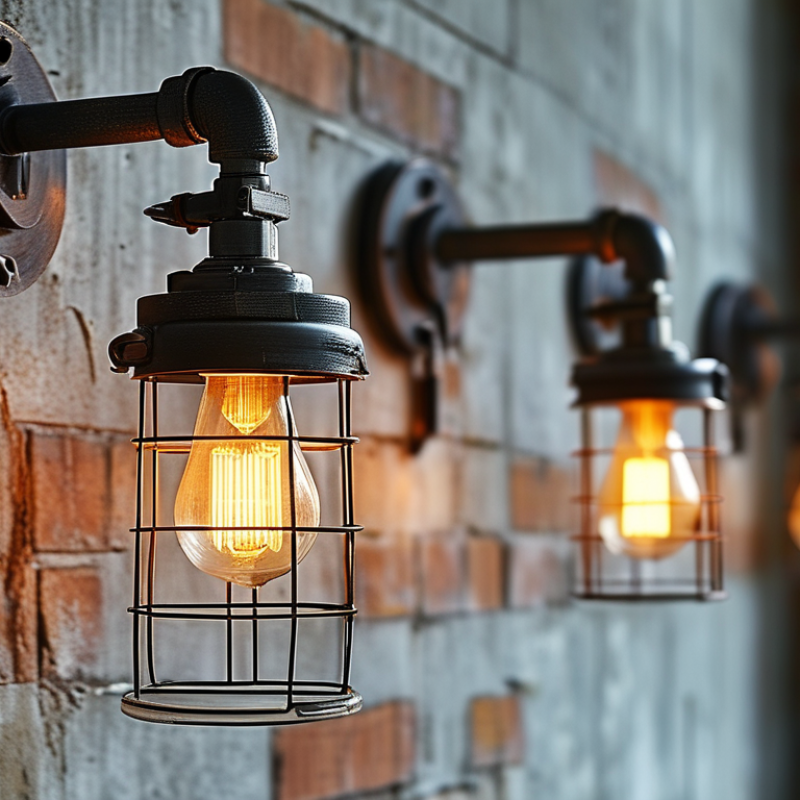
This guide examines the leading industrial sconce lighting types expected to shape commercial and residential interiors in 2026. Caged sconces remain popular for workshops, corridors, and restaurant exteriors. Their steel guards protect the lamp and create sharp shadow patterns across brick or concrete. Gooseneck and barn-style sconces offer wider downward coverage, making them useful above loading doors, kitchens, and covered patios. Globe sconces soften the look with diffused glass, while cone shades deliver a more focused, architectural beam.
Integrated LED sconces are gaining attention because they reduce lamp replacement and support dimming controls. Adjustable cylinder models provide cleaner lines for offices, galleries, and renovated warehouses. Weather-resistant finishes also matter. Powder-coated steel, sealed housings, and corrosion-resistant hardware can extend performance outdoors.
The choices are not flawless. Some cage fixtures collect dust. Some integrated LEDs are difficult to repair. Dark finishes may show salt deposits near coastal buildings. These details deserve honest consideration before selection.
The following sections compare each type by appearance, light distribution, installation setting, maintenance needs, and design value. Small differences matter. A wall can feel warm, dramatic, or strangely harsh.
Industrial Sconce Lighting in 2026: Definitions, Standards, and Main Types
Industrial sconce lighting means wall-mounted fixtures with practical forms and durable materials. Typical details include steel bodies, protective cages, exposed fasteners, and clear or seeded glass. The style developed from factory lighting, but modern interiors use it in corridors, restaurants, workshops, and homes. The category is not perfectly defined. Some decorative fixtures now borrow industrial features without meeting industrial performance needs.
The main types include cage sconces, gooseneck sconces, bulkhead sconces, cylinder sconces, and swing-arm models. Cage designs protect the lamp and create strong shadows. Gooseneck versions direct light downward across doors, signs, or worktables. Bulkhead fixtures suit damp or exposed areas when their ratings support that use. Swing-arm sconces provide adjustable task lighting. Cylinder models offer a cleaner, more architectural appearance.
Standards matter more than appearance. Check the fixture’s electrical safety certification, installation instructions, and location rating before purchase. IP ratings, defined by IEC 60529, indicate protection from dust and water. Local electrical codes still control final installation requirements. A qualified electrician should verify wiring, grounding, mounting surfaces, and junction boxes. Energy-efficient LED sources are common in 2026, but efficiency alone is not enough. Review color temperature, color rendering, glare, heat control, and replacement options. Warm light around 2700–3000K often feels comfortable, while 3500–4000K can support detailed work. In practice, I have seen attractive sconces fail because their light spreads poorly. The fixture looked right. The room did not.

Gooseneck sconces remain a practical choice for industrial exteriors because their curved arms direct light toward doors, loading zones, and walkways. A 2700–3000 K CCT creates a warmer, welcoming appearance near entrances. Around 3500–4000 K gives stronger visual clarity for work areas. The U.S. Department of Energy reports that LED lighting can use at least 75% less energy than incandescent lighting. Its longer service life also reduces frequent maintenance on high-mounted fixtures.
The IEA’s lighting analysis shows that efficient lighting can significantly reduce electricity demand worldwide. However, efficiency alone does not guarantee good exterior lighting. IES recommendations emphasize controlled distribution, suitable illuminance, and glare reduction. In practical installations, a shielded gooseneck sconce often performs better than a brighter, poorly aimed fixture. I have seen this mistake repeatedly. More light can create harder shadows.
Tips: Match the CCT to the setting. Use 2700–3000 K near hospitality entrances, and 3500–4000 K near service doors or active work zones. Check the photometric report, beam spread, and mounting height before ordering. For exposed locations, confirm the fixture’s weather rating and corrosion resistance. A dimming control may improve comfort, but it needs careful commissioning. Otherwise, the system can feel uneven and waste energy.
Gooseneck sconces support a broad 2700–4000 K correlated color temperature range, allowing warm architectural illumination through cooler task-oriented exterior lighting. Barn-style, bulkhead, and cylindrical sconces commonly use overlapping CCT options, depending on the required visual appearance, mounting location, and outdoor task.
What Are the 2026 Top Types of Industrial Sconce Lighting?
Caged wall sconces remain a strong choice for workshops, loading areas, stairwells, and utility corridors. Their metal guard helps shield the lamp from tools, carts, and accidental contact. An IK08 rating means the enclosure withstands impact energy of five joules under IEC 62262 testing. That protection is useful, but it does not make every fixture indestructible. Small detail, big consequence. The mounting surface, screws, and wall anchors must also handle vibration and repeated contact.
A well-designed industrial sconce places the cage slightly away from the diffuser. This spacing reduces direct pressure on the lamp and leaves room for heat to escape. In a real installation, check the guard welds, coating thickness, cable entry, and access for lamp replacement. A dark powder-coated finish can hide dust, while a lighter finish makes maintenance problems easier to notice. Not always attractive, but practical. The light distribution also matters; narrow beams can create harsh shadows between equipment, while wider beams improve visibility along passageways.
IK08 should be reviewed with the fixture’s IP rating, operating temperature, and electrical documentation. A cage alone cannot protect against water or chemical exposure. Poorly sealed cable glands may weaken an otherwise capable design. One common oversight is placing the sconce where forklifts can strike it directly. Relocating the fixture or adding a separate barrier may be wiser. Even careful specifications need an on-site review, because industrial spaces rarely match the drawings perfectly.
What Are the 2026 Top Types of Industrial Sconce Lighting?
Bulkhead sconces remain practical for dusty workshops, loading bays, and washdown corridors. Their IP65 enclosure is rated dust-tight under IEC 60529. It also resists water jets from any direction. It is not designed for immersion. That detail is often missed during product selection.
A well-designed bulkhead sconce uses a sealed body, protected gasket, and impact-resistant lens. These features help prevent fine particles from reaching the driver or terminal area. The U.S. Department of Energy reports that LED lighting uses at least 75% less energy than incandescent lighting and can last up to 25 times longer. However, real savings depend on operating hours, temperature, controls, and maintenance. Numbers on a datasheet are not the whole story.
Tips: Check the actual washdown method before choosing IP65. Confirm ambient temperature, mounting height, cable entry, and emergency lighting requirements. In field inspections, poor cable glands often weaken an otherwise strong enclosure. That is a useful warning. Also, avoid choosing maximum brightness alone; excessive glare can reduce visibility near machinery. A careful photometric review may reveal that fewer, better-positioned sconces perform more effectively. Regularly inspect seals for cracking, especially after repeated heat cycles and chemical cleaning.
The following comparison highlights common industrial bulkhead sconce configurations suitable for commercial, utility, transportation, marine, and outdoor service areas. Actual performance depends on the complete certified luminaire, installation method, ambient temperature, and local electrical requirements.
| Bulkhead Sconce Type | Typical Enclosure and Protection | Recommended Environment | Common Light Source | Typical CCT Options | Typical Lumen Range | Mounting Configuration | Key Advantages | Important Selection Notes |
|---|---|---|---|---|---|---|---|---|
| Standard IP65 LED Bulkhead | Sealed polycarbonate or glass-reinforced housing with an IP65-rated enclosure. IP65 indicates protection against dust ingress and water jets from any direction. | Workshops, warehouses, service corridors, plant rooms, covered loading areas, and exterior walls. | Integrated LED module | 3,000K, 4,000K, or 5,000K | 1,000–3,000 lm | Surface wall or ceiling mounting; conduit or cable-entry options are common. | Balanced general-purpose option | Verify ambient-temperature limits, cable-entry arrangement, impact rating, and emergency-lighting availability. |
| High-Impact IK08–IK10 Bulkhead | Reinforced polycarbonate lens and robust body designed for increased resistance to mechanical impact. The IK rating must be checked on the complete luminaire. | Correctional facilities, sports service areas, workshops, industrial walkways, and locations exposed to accidental impact. | Integrated LED module | 4,000K or 5,000K | 1,200–4,000 lm | Recessed, surface, or guarded wall mounting depending on the housing design. | Improved resistance to vandalism, tools, carts, and accidental knocks. | A higher IK rating does not replace the need for correct mounting, guarding, or site-specific risk assessment. |
| Marine-Grade IP65/IP66 Bulkhead | Corrosion-resistant polymer, stainless steel, or coated metal housing with sealed gaskets. IP66 provides protection against powerful water jets and is higher than IP65 for water ingress. | Coastal buildings, docks, shipboard service spaces, wastewater facilities, and high-humidity locations. | Integrated LED module | 3,000K, 4,000K, or 5,000K | 1,000–3,500 lm | Surface wall or ceiling mounting with corrosion-resistant fasteners. | Better suitability for salt-laden air, moisture, and frequent washdown conditions. | Check salt-spray testing, fastener material, gasket service life, and whether the rating applies with all accessories installed. |
| Emergency Bulkhead Sconce | Sealed IP65 or higher housing with a maintained or non-maintained emergency circuit and rechargeable battery system. | Escape routes, stairways, plant rooms, warehouses, public access areas, and locations requiring standby illumination. | LED module with emergency driver and battery | Typically 4,000K | Normal mode: 1,000–3,000 lm; emergency output varies by design. | Surface wall or ceiling mounting; self-test and remote-test versions may be available. | Supports emergency-egress lighting while retaining normal-area illumination. | Confirm emergency duration, battery replacement requirements, test method, photometric compliance, and local code requirements. |
| Photocell-Controlled Bulkhead | IP65 or higher sealed enclosure with an integral dusk-to-dawn photocell or external control connection. | Perimeter walls, entrances, utility compounds, car parks, and outdoor circulation routes. | Integrated LED module | 3,000K, 4,000K, or 5,000K | 800–3,000 lm | Surface wall mounting, commonly above doors and along access paths. | Automatic nighttime operation can reduce unnecessary daytime energy use. | Position the photocell away from direct luminaire light and verify compatibility with timers, sensors, or building controls. |
| Microwave or PIR Sensor Bulkhead | IP65-rated sealed housing with an integrated occupancy sensor or sensor-compatible control gear. | Low-traffic corridors, storage rooms, parking structures, stairwells, and service areas with intermittent occupancy. | Integrated LED module with dimming driver | 3,000K or 4,000K | 1,000–3,000 lm | Surface wall or ceiling mounting; sensor coverage depends on orientation and mounting height. | Provides occupancy-based switching or dimming to support energy management. | Review detection range, mounting height, false-trigger risk, minimum dim level, and compatibility with other control systems. |
| Guarded LED Bulkhead | IP65 enclosure fitted with a metal wire guard or protective grille over the lens. | Industrial workshops, plant rooms, loading bays, agricultural buildings, and areas with moving equipment. | Integrated LED module | 3,000K, 4,000K, or 5,000K | 1,000–3,500 lm | Surface wall or ceiling mounting with a protective guard secured to the body. | Helps protect the lens from direct impact and contact with equipment. | Clean the guard and lens regularly because dust accumulation can reduce light output; confirm the guard does not compromise the certified rating. |
| Low-Temperature Bulkhead | Sealed IP65 or higher housing with a driver and battery system rated for cold ambient conditions. | Cold stores, refrigerated loading areas, external plant, unheated warehouses, and winter-exposed walkways. | Integrated LED module with temperature-rated driver | 4,000K or 5,000K | 1,000–3,000 lm | Surface wall or ceiling mounting with suitable cable glands and fixings. | Maintains more reliable operation where low temperatures can affect standard drivers or batteries. | Check the certified operating-temperature range, start-up performance, condensation control, and emergency-battery temperature rating. |
| Hazardous-Area Certified Bulkhead | Specially certified enclosure for specified explosive-gas or combustible-dust zones; protection is not established by IP65 alone. | Only for hazardous locations identified by a formal area classification, such as selected process, fuel, or dust-handling areas. | Certified LED module and driver assembly | 3,000K, 4,000K, or 5,000K | 1,000–5,000 lm | Surface wall or ceiling mounting using approved glands, brackets, and accessories. | Designed for applications requiring additional ignition-protection certification. | Match the equipment certification to the exact gas or dust group, temperature class, zone, installation method, and jurisdictional requirements. |
Selection reference: IP65 and IP66 describe ingress protection, while IK08–IK10 describe impact resistance. Neither rating by itself confirms suitability for hazardous areas, marine exposure, emergency use, or low-temperature operation. Always review the luminaire’s complete technical documentation and applicable installation standards before specifying or purchasing in bulk.
Industrial sconce lighting in 2026 is moving beyond rugged appearance. Common formats include cage sconces, shielded wall lights, and up-down LED sconces. Up-down models combine directional light with efficient wall illumination. A typical fixture sends light upward for ceiling bounce and downward for task visibility. Look for CRI ≥80 and efficacy above 100 lumens per watt. These figures can reduce energy use without making corridors feel cold. In workshops, entries, and hospitality spaces, the split beam adds depth to brick, concrete, and textured metal surfaces. The effect is practical, not merely decorative.
From installation experience, beam control matters as much as lumen output. Narrow upward optics create a sharp ceiling patch, while wider lenses soften the room. An aluminum housing, sealed driver compartment, and effective heat path can support longer service life. However, published performance may change after dimming, high ambient heat, or frosted diffusers. That weakness deserves attention. Check photometric files, operating temperature, dimming compatibility, and measured driver efficiency before choosing a fixture. CRI ≥80 is a sensible baseline, but sensitive materials may look better near CRI 90. Mounting height also affects glare and useful illumination.
Tips: Install one sample at the actual wall height. Measure light at the floor and work surface. Compare the upward glow after dark. Allow for imperfect conditions. Dusty lenses and aging drivers can reduce real output. Request independent test data and a clear warranty.